Using your vacation to do good

August 23, 2016

Wisconsin State Journal
By LISA M. DIETLIN For Lee Enterprises

Are you always in search of that one-of-a-kind special vacation? Are you constantly trying to find time to do good?

There' s a tremendous opportunity to have a very special vacation, meet amazing people, visit places you' ve never been all while making a difference by taking part in voluntouring or in a do-good vacation.

China Calvin 167Voluntouring is a chance to  participate in programs around the world that make a difference within a short time frame " anywhere from one week to about three months, while vacationing!

Because you’re donating your time and effort to a nonprofit organization, a significant portion of your vacation costs may even be tax deductible.

Here’s how voluntouring works:

You will be working side by side with a community and its residents.

Voluntouring vacations are available around the world in Latin America, Eastern Europe, Africa, Asia.

The projects cover many important areas, such as children, the environment, health care, education, historic restoration, animal conservation, senior care, construction and others.

Voluntour participants often speak about building tremendous new friendships that last for many years.

While some trips are for adults only, there are many that are appropriate for families and young people.

Voluntourism has become both a big and global business primarily supported by the increasing desire of travelers to take worthwhile and meaningful trips while trying to do some good.

Examples of voluntouring vacations

Through Projects Abroad, a two week program offers voluntourists the opportunity to work in archaeological ruins of ancient pre-Inca structures in Peru. Anyone 16 years or older can participate. The work would include preliminary investigations, excavations, analysis and registration of cultural materials, site visits, office registry work, working at museums, archaeology presentations, classification of ceramics and community activities including working at an elementary school. The group also organizes social events for volunteers.

Another example of a trip takes place with Greenforce (www.greenforce.org); for approximately $3,900 you can work to save the endangered orangutans in one of the oldest and most beautiful rain forests in Borneo.

Other types of trips include voluntourists working on restoring temples by spending half the day cleaning paintings or building walls with the monks. The rest of the afternoon they spend their time sightseeing.

Or a penguin rescue and rehabilitation program in South Africa with accommodations and a meal allowance during six weeks of catching, feeding and cleaning up after penguins and other seabirds. But you also have two days off per week to sightsee.

The possibilities and opportunities are truly endless.

Alternatively, you might also want to consider a do-good vacation, which includes travel to more common holiday destinations in places like Ireland, Italy and Spain. These vacations are different from voluntouring in that you will be working with a nonprofit to raise money for a cause and not be working in a local community.

Often travelers create their own trip by raising money or awareness on behalf of a cause or organization that is near and dear to their hearts. Work with your favorite nonprofit organization to create a plan of action that includes doing good on your next vacation.

Tips for voluntouring

  •     Find an organization that matches your passion and has a proven track record.
  •     Select a trip that suits your abilities and interests and be prepared to work!
  •     Speak with people who have been on the excursion before or worked with the company you choose.
  •     Learn about local customs " even a bit of the language " before you go, but be prepared for a trip that may be tremendously different from what you might expect.
  •     Expect none of the comforts of home, in other words, you will be “roughing it.”

Wisconsin State Journal

How to Do It All including volunteer vacation

How to Do It All High Resolution 188x300Writer Linda Formichelli’s new book “How to Do It All: The Revolutionary Plan to Create a Full, Meaningful Life ' While Only Occasionally Wanting to Poke Your Eyes Out With a Sharpie” has a chapter on volunteering and features Globe Aware as one of the resources.

Formichelli considers the fact women want to do, see, and experience everything they can to create a rich, memorable life, including rraveling, volunteer work, athletic events, entertaining, reading, learning, and trying new things but life and responsibilities get in the way.

She offers a plan on how to do it all:

  • Why stress should be welcomed, not avoided.
  • The importance of living a do-it-all life.
  • Why you shouldn' t expect support from your family…and where to get it instead.
  • Why you should shower less, sleep less, talk to yourself, and be inconsistent ' and how this can help you live a more memorable life.
  • How you can get it all done even when right now you have no time, no money, and no motivation.
  • The revolutionary plan to accomplish everything you dream of doing in your life (includes free worksheets!).

Learn more here

Self

Give Back While You are on Vacation

Emma Sarran Webster writing for Teen Vogue explores how to turn spring break into a truly worthwhile, beneficial vacation through a volunteer vacation with Globe Aware and other working vacation facilitators.


6 Spring Break Ideas That Allow You to Give Back While You Vacation

From a Kindergarten in Argentina to the health campaigns in Ghana.

This Spring Break, take the opportunity to travel and help others, through a volunteer vacation. The combination of volunteering and travel is growing in popularity as an increasing number of companies offer the chance to explore and make a difference. You can take your pick from working at orphanages in Africa, assisting in wildlife conservation efforts in South America, or protecting natural environments right here in the States. "Volunteering overseas is, without a doubt, one of the top experiences anyone could hope to undertake in their lifetime," Dr. Ken Dorman, a board member of service travel organization Globe Aware, wrote on their website. "Even a short-term volunteer adventure can change your life and world perspective. Few things can give you a greater sense of meaning." So as you plan your Spring Break, consider gaining perspective through one of these six companies that offer service trips at home and abroad.

Globe Aware

Globe Aware offers 8-day, Saturday-to-Saturday international volunteer vacations ' perfect for a full and fulfilling Spring Break. The company focuses not on giving charity, but on helping host communities build renewable, sustainable programs. "The goal is not for volunteers to change the host communities, but rather to help them in the needs that the host community has identified as important," the Globe Aware site states.

As a Globe Aware volunteer, you can travel to places like Cambodia to help with reforestation efforts; Brazil to help build a community center; or Romania to help teach English. And fear not: You don' t need any special skills or prior qualifications to join; the volunteer coordinators will help you throughout the process. Book your trip as a solo traveler, with your family, or even a group of girlfriends.

Projects Abroad

Projects Abroad, a company that sends more than 10,000 volunteers overseas every year to work on service projects, offers week-long Alternative Spring Break Trips designed specifically for college students. Sign up to volunteer at a kindergarten in Argentina or Fiji; help with public health campaigns in Ghana; participate in renovation work in Morocco; or help protect sea turtles in Mexico, among other options. Not in college yet? Check out Project Abroad' s High School Special programs.

Fathom

Fathom gives travelers the chance to head out on a cruise ' with a purpose. Depart by sea from Miami to one of two Caribbean destinations: the Dominican Republic or Cuba. While on board the ship, you' ll get to know your fellow travelers, learn about your destination and its customs, and participate in orientation activities and lessons that will prepare you for your on-land experience. Sail to the Dominican Republic to serve the local communities through projects like working with a women’s collective on their successful artisanal chocolate business, or helping locals gain access to clean water. Or immerse yourself in Cuban culture through visits with Cuban professionals, entrepreneurs, and family business owners to learn about education, economics, the role of government, and more in this country that was, until recently, mostly off-limits to American travelers.

Sierra Club Outings

Sierra Club is the country' s largest grassroots environmental organization, on a mission to "explore, enjoy, and protect the planet." As part of that mission, Sierra Club Outings offers environmentally friendly, outdoor excursions throughout the year ' among them, inspiring and adventurous service trips. Head to Big Sur State Park to help with trail improvements; to New York City to assist with maintenance and invasive species removal in the Thain Family Forest; or to Florida to work on restoring the ecosystem on the island of Cayo Costa.

Earthwatch

Earthwatch Institute gives adults and teens alike the chance to work with scientists on various expeditions focused on protecting the planet and its species. As a "citizen scientist" on an Earthwatch Expedition, you can explore the impact of climate change on the Mojave Desert and Joshua Tree National Park; research ocean health as it pertains to whales and dolphins in Costa Rica; or learn about wildlife and ecosystems as you help conserve river dolphins and monkeys in Peru' s Amazonian forests.

American Hiking Society

American Hiking Society (AHS), a national organization that promotes and protects foot trails and the surrounding natural areas, offers volunteer vacations focused on building and maintaining trails throughout the country, with a healthy dose of backpacking or day hiking. Explore AHS' s Project Guide to find a trip that' s right for you, whether that' s assisting with boardwalk maintenance at Virginia' s Kiptopeke State Park; protecting the sand dunes at Indiana Dunes National Lakeshore; or helping construct a new trail at the Big South Fork National River and Recreation Area in Tennessee.

AHS also offers Alternative Breaks, open to groups of 8-15 students who sign up together and are touted as "part volunteer work project, part kick-back outdoor vacation" on the website. Though the Spring Break trips are full, summer trips to places like Texas, Florida, and California are open ' perhaps a sign to get a head start on your summer break planning?

Teen Vogue

Family Volunteer Travel

Writing for Chase magazine, freelancer Michelle Seitzer looked at the myriad opportunities and ways to turn a regular vacation into a meaningful vacation through volunteer travel. Globe Aware founder Kimberly Haley-Coleman offered some great insight on what to look for and how to pick volunteer vacations that provide the best return for destination communities and countries.

Family Travel That Gives Back: A Meaningful Vacation

Going Away for a Good Cause
By Michelle Seitzer

Americans sometimes choose work over play — a 2014 study found that more than 150 million vacation days go unused every year — but a new kind of family adventure may be just the thing to give today’s modern family a high-quality break.

A volunteer vacation, or service trip, offers an opportunity to do good while working together as a family. A growing number of organizations now make it possible to do it without spending weeks or months away.

founderkimberlyKimberly Haley-Coleman founded Globe Aware to weave her passion for cultures, languages, and out-of-the-box travel with the strong demand for short-term volunteer trips. Her non-profit fosters "a mutual learning experience" benefiting travelers and individuals in needy communities worldwide.

"We' re not putting people on ladders or going into war zones," says Haley-Coleman. The liability is too high for her small company, and it' s not their mission " which may come as a relief to those worried about the challenges of global volunteer work.

Globe Aware specializes in community-driven projects that can be completed in a week, from Saturday to Saturday, without need for language or technical skills. And there are no age restrictions. Participants have ranged from 2 to 95 years old.

Most of the week is devoted to project work and organic interactions with local residents, but volunteers still visit landmark sites like Machu Picchu and Angkor Wat. "We go to tourist favorites but focus on the cultural awareness window to the world," she says.

"It' s tangible, visible giving, not just writing a check."

Kimberly Haley-Coleman, Globe Aware

On one of their Cambodia trips, volunteers assembled wheelchairs for land mine victims. In Guatemala, they installed concrete floors and outdoor garden spaces in the homes of impoverished single mothers.

"It' s tangible, visible giving, not just writing a check," says Haley-Coleman.

First-World Problems, Illuminated

Waiting to complete an international adoption inspired Mary Voorhies and Philip Southwick to take a working vacation to Nicaragua, where they helped to deliver clean water and establish modern bathrooms in rural communities.

For Voorhies, the most valuable takeaway was this realization: "Road bumps in my every day life are all now first-world problems."
An Unexpected Gift … and Guilt

Krista McKay accompanied her nurse-practitioner mother on a medical mission trip to Honduras that she described as "an operation in improvisation." The small but mighty team of doctors, surgeons, and nurses from a suburban Philadelphia hospital has visited the same villages for more than five years now. Though she is not a healthcare professional, McKay was invited to join the group on a recent visit after lending her marketing and fundraising expertise because the volunteers have to cover all costs themselves, including medical supplies.

In the heart of the village, the group sets up mobile clinics where locals line up to be seen for anything from common cold symptoms to gaping wounds to complications from diabetes. They also perform surgeries in the local hospital, where the team scrubs with a wash basin because there' s no running water. Patients wait with outdated x-ray printouts while wild dogs run in and out of the building.

The strengthened relationship McKay and her mother gained from working side-by-side in hard healthcare situations " treating seizures on the spot, in one instance " made the trip worthwhile. Still, McKay returned with mixed feelings. "I didn' t feel like what I did was enough. You feel good for doing something good, but you also have guilt for having more than you need."
Planning a Giving Vacation

Motivated to make a difference in someone else' s life " yours included " on a service adventure abroad? There are risks and rewards associated with giving this way, which is why you should do adequate research when choosing an organization to handle your trip, says Haley-Coleman.

Unsure about bringing younger family members? Evaluate what exposure they' ve already had, and consider a closer-to-home Latin American country vs. crossing an ocean for their first experience.

Choosing to do good on your next family vacation instead of simply consuming goods (or staying behind the desk and letting your employer have your unused vacation days) is a wise investment that can pay off in many ways.


Self

Volunteer Vacations’ Growing Popularity

vOLUNTEER VACATIONS POPULAR" Volunteer vacations' a popular trend for many

By Jackie Runion

Marietta Times

Anyone vowing to travel or to make a difference in the new year can do both at the same time in the form of a “volunteer vacation.”

A number of companies, organizations and programs exist to offer people of all ages a chance to volunteer and help others while on vacation, whether it be either a car ride or a long plane trip away.

A popular trend that comes in the form of mission trips, alternative spring breaks and state and nationally-organized charity projects, the concept of volunteer tourism can give people a chance to get out of their backyards and also make an impact in their state, country or in a community overseas.

FACT BOX

Volunteer vacation opportunities

Volunteer Match

  • Features: Database directory of service opportunities for 99,000 nonprofits across U.S. that provide search-by-location and service-type engines.
  • Requirements: Vary by project.
  • Ages: Accepts all ages.

Globe Aware

  • Features: Worldwide, week-long volunteer projects.
  • Requirements: Cost and application required, trips are tax-deductible.
  • Ages: All ages accepted, children 15 and under must travel with a parent or guardian.

Projects Abroad

  • Features: Variety of service projects in East Europe, Africa, Asia and Latin America.
  • Requirements: Application required.
  • Ages: Teens and older.

American Hiking Society

  • Features: Week-long trail and park maintenance projects across the U.S.
  • Requirements: Varying fees and registration required.
  • Ages: All ages accepted, volunteers under the age of 18 must be accompanied by an adult.

Ohio Department of Natural Resources:

  • Features: Various volunteer activities for groups and individuals of all ages across Ohio’s 74 state parks.
  • Requirements: None.
  • Ages: All ages accepted.

In the area, common traveling service projects are found most frequently through colleges and churches.

Marietta resident Terry Schmelzenbach is one of many people who found a passion in overseas mission work through his church.

Through the Marietta Church of the Nazarene, Pastor Schmelzenbach has taken multiple trips to Swaziland, Africa, not only to experience the beautiful scenery and wildlife, but to help others.

“We’ve had a presence there since 1908,” Schmelzenbach said. “The Church of the Nazarene has a large base there, and we educate about 32 percent of the people in that country.”

Schmelzenbach said the groups, which typically consist of just fewer than 20 people and with all ages involved, help work on the country’s two colleges and help with various building projects and food needs in the area.

“It’s things as simple as laying and cutting tile for floors and stuff like that for buildings over there,” he said. “When you’re worrying about where your next meal is coming from, you don’t worry about stuff like that.”

The group often takes clothing and food to help out the locals in addition to delivering sermons.

“We turn it into a 50/50 deal,” Schmelzenbach said. “The rest of the time we spend in Kruger (National) Park, where all the safari animals are, and we stay the night there in a fenced-in area.”

Schmelzenbach said he and his wife save up to go on the trips every few years, including one coming up in June.

“The average lifespan is like 32 years of age, and $10 a day is considered a good job, so they know you’re there for them,” he said. “We go over there and feed them, but we also work with them.”

Through organizations like Projects Abroad and Global Aware, people of all ages can pay for tax-deductible vacations connected to national and international service projects.

Through Projects Abroad, which sends some 10,000 volunteers around the world each year, applicants can travel across the world to build schools, teach, conserve wildlife and provide childcare.

Many Projects Abroad trips allow anyone 16 and older to join, while short-term programs like Alternative Break Trips and High School Specials offer similar experiences for college students and teens.

“Alternative Spring Break trips are designed with short-term volunteering in mind and give college students the chance to break away from the usual spring break experience and give the gift of service to those in need,” said Tom Pastorius, the head of recruitment for Projects Abroad.

And Global Aware also offers its own volunteer vacations that provide teaching, clean-up, building and other types of activities within the U.S. and abroad.

Other companies and their respective websites, like volunteermatch.org and voluntourism.org, provide similar matching opportunities to either allow groups and individuals to directly apply for a service project or to provide resources about projects across the nation and how they can get involved.

Marietta resident Kevin Ritter is the owner and founder of Coast to Coast Athletics, a Marietta company established in 2002 that not only provides scholarships to local students, but provides teaching opportunities to children and teenagers around the world.

“On the service side we are involved in baseball clinics, and we’ve done these in Europe, Puerto Rico, Australia and in Florida,” Ritter said.

The program offers $1,000 scholarships to area Washington County students that staff deem college-ready, both to give them a head-start in paying for tuition while also providing an opportunity to teach the sport to their peers and to younger children across the world.

Domestically, a popular volunteer opportunity for outdoor fanatics is through the American Hiking Society.

Self

8 Reasons to Take Your Teens On a Volunteer Vacation

DSCN3001By Sucheta Rawal

Travel Writer

Posted: 06/09/2014 4:27 pm EDT Updated: 06/09/2014 4:59 pm EDT

Huffington Post, Travel Section

Volunteer vacationing, or voluntourism, is a relatively new phenomenon that includes a service component built into a short-term vacation. Don’t confuse it with a mission trip, which is a trip designed specifically to work on a charity project or spread the philosophy of a religious group, or with the Peace Corps, which offers an opportunity to live and volunteer abroad for extended periods of time. The idea behind a volunteer vacation is to give back to the community you are visiting while having fun and learning about the local culture.

This type of a meaningful summer getaway can be especially useful for teenagers. Imagine a real-life lab where teens are learning as well as contributing. Choose any topic of interest to plan your themed trip, including the environment, health, education, micro lending, crafts, firefighting, sports, animals or construction. Most organizations require no prior experience or special skills but may not admit children less than eight years old.

1. Learn the real culture

International travel provides the opportunity for a great learning experience, but if you only take group tours and do solely tourist activities, you never really learn about a place’s true culture. Volunteering makes you get out there and meet the locals, as well as talk to and work alongside them. When you are forced into a situation where you are interacting with the locals everyday, you start to pick up on their cultural nuances and understand their culture on a deeper level. The recipients also feel grateful for your contributions and may invite you to private dinners, family gatherings or festivals that you wouldn’t otherwise have access to.

2. Strengthen family bonds

Traveling is a family bonding experience, but doing projects while traveling builds a sense of teamwork. Kids of all ages can work together building homes in villages, sowing seeds at community farms, taking care of animals at sanctuaries or engaging street kids in sports. Grandparents, uncles and cousins who don’t get to spend time with each other outside the once-a-year Thanksgiving or Christmas get-together can hang out as well as feel good about making an impact.

3. Be a positive role model

When your kids see you working hard to build toilets for village schools versus sipping margaritas on the beach, they develop a deeper admiration for you. As a parent, you become a positive role model who encourages them to think beyond themselves and to lend a helping hand to the global community. You empower your kids to be responsible, compassionate and good global citizens by leading by example.

4. Prepare the leaders of tomorrow

Working abroad as a volunteer helps teach greater tolerance and understanding towards people from diverse cultural backgrounds, lifestyles, ages and income levels. It helps young people break down stereotypes at a young age and grow into responsible, caring leaders. According to certain studies, adults who volunteered as kids were twice as likely to be involved in community service as adults who did not. If you expose your kids to volunteering at a young age, they are likely to become contributing members of society and future change agents.

5. Get a break on your taxes

Many volunteer vacations are tax deductible. If you are traveling with a registered charitable organization and the main reason for your trip is to do volunteer work, you can deduct all or most of the expenses you incur. For a family taking an international trip, the savings can amount to thousands of dollars.

6. Leave a positive footprint

Going on a volunteer vacation as opposed to a regular one will always leave a positive footprint. When you depart a destination, you bequeath something of value to the locals that will help them in their future. Weather you teach English to women or bring smiles to the faces of little kids, it is certain that the impact of your visit is much more than the dollars you spend at the hotels and restaurants.

7. Build your teen’s resume

Any volunteer work adds value to college applications. Teens can draw references from their experiences of traveling internationally, seeing how people live in different parts of the world, and helping make a positive impact. It provides them with great content that is relevant in class discussions, interviews and term papers. It also boosts their confidence and social skills.

8. Make them appreciate what they have

Perhaps the greatest benefit of a volunteer vacation experience is making your teens appreciate the lives they have and halting the trap of overconsumption. Witnessing how the majority of the world’s population lives without 24-hour running water, electricity, down comforters and overstocked pantries is truly an eye-opening experience for which no textbook or documentary film can substitute. After making friends with others of a similar age who live with very little, they will probably not demand the latest electronic gadgets next Christmas!

Volunteers share hearts, experience

A former school principal and business executive look abroad for adventure and volunteer opportunities. They find their calling overseas working with communities in Africa and Eastern Europe:

LI volunteers share their hearts, experience abroad

Published: April 4, 2014 8:56 AM
By CARA S. TRAGER  Special to Newsday

For Helen Boxwill, it was as simple as this: Retire? YES. Rest and relax? NO!
So, in 2003, after a 23-year career in education, including three years as principal of Southdown Primary School in Huntington, Boxwill answered an ad for volunteer teachers in Africa. Nine months later, Boxwill landed in a remote Ethiopian village called Hosanna. It has since become her home away from home, she said.
Boxwill, 68, a divorced Huntington Station resident with three grown children, returns at least once a year, staying three weeks to 12 months, while pursuing different projects. During her time there, she said, she has developed a community library in Hosanna; expanded and refurbished a school in Tetema, a community 25 miles from Hosanna; and instructed college faculty on training new teachers. h2Empower, a nonprofit she established in 2006, provides financial contributions for her projects, and Long Islanders, including schoolchildren and her church’s members, have supplied books and other materials.
“I have found my purpose in life,” said Boxwill during a Skype interview from Ethiopia. “Everything I’ve learned or done professionally, I can apply in a place where my experience can make a difference.”
For some Long Islanders, retirement, sabbaticals or vacations are an opportunity to volunteer, pursue an interest or travel to distant lands. Some manage to accomplish all three by volunteering overseas. “It gives you the advantage of seeing a new culture and new ways of living and looking at the world and an appreciation that the grass is not greener on the other side or, if it is, it can give a new sense of purpose,” said Jaye Smith, 59, a Sag Harbor executive coach and author of “Reboot Your Life: Energize Your Career & Life by Taking a Break.”

More boomers volunteer

There are no hard statistics on how many boomers volunteer abroad, but the 50-plus crowd has represented a steadily increasing percentage of Peace Corps volunteers since 2006, according to spokeswoman Elizabeth Chamberlain. Currently, 8 percent, or 577, of its 7,209 volunteers are 50 or older.
With many retired from teaching or running a business or nonprofit, the corps’ older volunteers know how to work with groups and motivate the local population to ensure a project’s continuity, Chamberlain said. And because the organization typically places volunteers in areas where the culture venerates elders, their age is an asset, too, she said.
But volunteering can be challenging, experts said. In underdeveloped regions and non-Western countries where volunteers often serve, Internet service can be sporadic and local cuisines may not be compatible with the average gastrointestinal system. In addition, certain prescription medications may not be available, and top-notch medical care may be difficult, if not impossible, to find, experts said.
Volunteering overseas also means acclimating to new environments. For instance, in Ethiopia’s capital, Addis Ababa, where few traffic lights exist, Boxwill said she follows other pedestrians when crossing a street, and during rush hour traffic jams, she forgoes public transportation and walks everywhere.
For the adventuresome and altruistic, though, overseas opportunities abound. A Google search for “overseas volunteering opportunities” will generate a lengthy list of nonprofits with programs abroad. The Peace Corps, which generally requires a 27-month commitment, offers assignments in 40 countries, such as teaching English in China. Globe Aware, a nonprofit that develops short-term, international volunteer programs, has projects in 17 countries, including Cambodia, where volunteers assemble and distribute wheelchairs to land mine victims, an official said. Project HOPE has been sending health care professionals throughout the globe to provide medical assistance since 1958, according to its website.
Agency policies differ regarding program duration and who picks up the tab for transportation overseas, daily lodging and meals. For example, Globe Aware’s tax-deductible program fee, which covers food, accommodations, medical care and a bilingual coordinator, costs each volunteer $1,100 to $1,500, depending on the project, a spokesman said.
Given the commitment that overseas projects often require, Smith suggested that potential volunteers test the waters by participating first in the efforts of a local nonprofit involved with international programs. The local experience can help volunteers become confident and comfortable working with the population the organization serves and determine whether they can add value to its overseas work, she said.

Back to Kenya

Since 2005, Kenyan-born Anne and George Mungai, who live in Baldwin, have volunteered annually for one month in an orphanage and school they founded in Wangige, a suburb about 16 miles from Nairobi. The Caroline Wambui Mungai Children’s Home pays tribute to their daughter, who died nine years ago of lupus. Caroline, then 25, was pursuing a master’s degree in early childhood education and had envisioned starting a school for Kenyan children in need.
“We lost our daughter and gained 40 children,” said Anne Mungai, 60. “We are carrying on her dream.” Both parents have doctorates. She is chairwoman of the Curriculum and Instruction Department and director of the Special Education Graduate Program at Adelphi’s Ruth S. Ammon School of Education. George, who is 63, teaches math at a Brooklyn high school.
They started the children’s home by donating a four-bedroom house and 31/2 acres they inherited. The site now encompasses nine buildings, including classrooms, dormitories and a dining hall. George designs the classrooms and supervises the construction, keeping track of their progress through photos that are emailed to him.
“We are rescuing these children from poverty to destiny, which is our motto, and we want them to be independent and stand on their own,” said George. “And that’s what the kids want, too.”
With three daughters, all in their 30s, accompanying them to the orphanage, the Mungais work in the kitchen, read to the children and take them to the doctor, pitching in wherever they are needed.
“If they need a hug, I give them a hug,” Anne said.
“I feel so gratified and so fulfilled that we are living my daughter’s legacy, multiplied many times over,” George said. “It’s not just what we are doing for one generation, but I believe the children will give back.”
Along with organizing fundraisers, receiving financial support from Adelphi students, alumni and her colleagues, many of whom have volunteered at the home, the Mungais contribute part of their salaries to the Caroline Wambui Mungai Foundation, which sustains the facility.
“When I go to the orphanage, I think I am going to help, but the children help balance me to see what’s important in life,” said Anne. “When we see the children in good health and the love they feel, it gives us joy.”

Philanthropy and photography

Volunteering has allowed Hollis Rafkin-Sax, 58, to channel a passion for travel overseas and photography into a philanthropic endeavor.
In 2008, Rafkin-Sax left the global crisis communications company she helped build. After enrolling at the International Center of Photography in New York City, she completed the yearlong general Studies degree program in 2010. Since then, she has participated in humanitarian missions with various organizations. On each trip, she has gone beyond the group’s activities, taking photos and providing them at no charge to the nonprofits to use in printed materials and websites.
“I have always loved photography and wanted to use it in a way I could give back,” said Rafkin-Sax, who is married with two grown sons and has homes in Sag Harbor and Larchmont.
In 2012, she spent two weeks in Bosnia, courtesy of a mission organized by the nonprofit Women’s World Banking. While there, she took photos and shared her marketing experience with young women entrepreneurs.
And as a participant in a one-year fellowship last year under the aegis of the American Jewish Joint Distribution Committee, an international social service agency, Rafkin-Sax delivered food staples and medicines to the homes of impoverished, elderly men and women in the Ukraine and Hungary. The fellowship also involved a mission to Haiti, where she advised student leaders on entrepreneurship.
Wherever she has lent a hand, Rafkin-Sax said, she has not only been moved by the people she helped but also by other volunteers.
The committee “changed my whole way of thinking about the world and who the unsung heroes are,” she said. “You go to disaster places, like Haiti, and you see people who have given up their relatively comfortable lives because they want to help, and that’s hugely impressive.”

GO IN WITH YOUR EYES OPEN

Think you might be interested in volunteering overseas? Here are experts’ tips for a positive experience.

  • Learn about the destination and its year-round climate, which could include drought and rainy seasons, as well as scorching temperatures, by contacting former volunteers and by researching online.
  • Visit a doctor specializing in travel medicine for vaccinations, medications and health-care advice.
  • Review the U.S. State Department’s website for travel alerts and warnings about your destination.
  • Don’t bring expensive or flashy jewelry.
  • Limit how much cash you carry each day.
  • Follow the local dress and etiquette code.
  • Only drink bottled water.
  • Keep travel documents in a safe place.
  • Be open to different people and a different culture.

Long Island Newsday

You’re Retired? How to Volunteer Overseas

volunteer-vacation-peruAugust 16, 2013 – 2:30 AM
By Susan Ladika

Remember when you were young and idealistic, and wanted to make a difference in the world?

Now that you' re retired, you have your chance.

Baby boomers and members of the Silent Generation are flocking overseas to take part in volunteer vacations.

You' ll be in good company if you head abroad to volunteer. Those age 65 and older are the fastest-growing group of international volunteers, soaring nearly 75 percent, from about 73,000 in 2008 to 127,000 in 2012, according to the U.S. Census Bureau' s Current Population Survey. For those between the ages of 55 and 64, the number of people volunteering internationally jumped from about 102,000 in 2004 to 161,000 in 2012.

Where to look

So how do you find opportunities to volunteer abroad?

There are two good places to start " the Internet and a religious organization. In fact, of all those who volunteered abroad, regardless of age, nearly half were connected to a religious organization, the Census Bureau found.

You' ll find opportunities detailed online with organizations connected to Protestant, Catholic, Jewish and Islamic faiths, or perhaps with your own church, synagogue or mosque.

Your other option is to plop yourself in front of your computer to search out organizations, and you' ll come up with a wealth of opportunities. These were recommended by SavvySenior.org founder Jim T. Miller on The Huffington Post:

  • Earthwatch Institute. "Expeditions" focus on environmental research and conservation.
  • Globe Aware. This group offers volunteer vacations of a week or more.
  • Global Volunteers. It offers volunteer vacations of one to three weeks.
  • Road Scholar. This group used to be known as Elderhostel.
  • Habitat for Humanity. You can volunteer with this well-known charity overseas.
  • Another site we recommend is Projects Abroad.

What to expect

Where you go and what you' ll be doing on your volunteer vacation depends on your own interests and skills. You can find opportunities in dozens of countries, from Poland to Peru.

You might be able to tap into the skills you' ve honed in your professional life, or choose something that simply appeals to you. Tutoring, general labor, mentoring youth and providing medical care are some of the most common ways that volunteers spend their time abroad, the Census Bureau survey found.

Once you' ve found something that piques your interest, you' ll need to fill out an application for that position.

In many cases you' ll work alongside locals as you do your tasks, so not only will you be able to share your skills with others, you' ll likely be developing new skills, while having the chance to immerse yourself in the local culture. Many programs also set aside time so you can take part in cultural activities.

What are the costs

It often will cost you a couple of thousand dollars to volunteer for a week or two abroad. Typically that will cover your accommodations, food and local transportation, and you' ll usually need to pay your airfare separately.

If it' s not included in the fee you pay to the organization, make sure to purchase travel insurance in case your travel plans go awry, and health insurance if your coverage doesn' t apply overseas.

While the costs of an international volunteer vacation may seem steep, because you' re volunteering with a nonprofit you' ll be able to deduct your expenses from your taxes.

Retirees, does the idea of volunteering in a foreign country appeal to you? Have you done it? Share your experience on our Facebook page.

MoneyTalks News

Family Volunteer Vacation in Cambodia

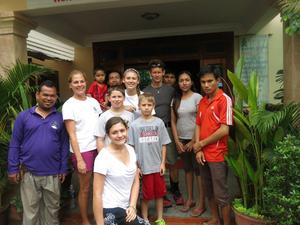
our family and meangs familyA Dallas family' s week-long volunteer vacation in Cambodia harvested a new global perspective for their four children, ages 10-17. Feeling that their kids were at an age where they were ready for a different type of travel experience, parents Stan and Lezlie decided a family service trip with Globe Aware was the perfect fit for them. Their goals were two-fold: to have their children understand that satisfaction and happiness are not tied to material wealth, and to have them understand that humans are the same around the world and that we all have more in common than differences. Prior to departing, Lezlie and Stan discussed expectations with their children to help prepare them for the poverty and difficult scenes they might encounter during their trip. While the children may have been ready for the work they would do and the people they would meet, nothing could have prepared them for the overall eye-opening experience that would ultimately change their lives.
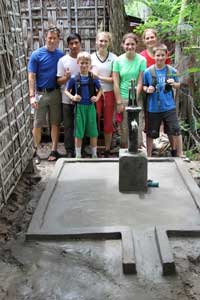
For their volunteer project, the family spent time building a well for the community, assembling and distributing wheel chairs to landmine victims, and teaching English at Friends of the Orphan Children Organization (FOCO), a local non-governmental organization that provides schooling for disadvantaged children in Siem Reap. It was during their time at the school that the family became intimately acquainted with the richness and reality of the Cambodian culture.

Claudia, the family' s 15 year old, was taken aback by the positivity of the Cambodians amidst their living conditions. Over 30 children both attended school and lived together in a small facility that Claudia quickly realized was not even half the size of her entire house. Yet despite their living conditions and lack of material luxuries, the children were full of joy, respectful, and welcoming to friends and strangers. Caiden, the family' s youngest, also noticed the unquenchable joy of the Cambodians: "The kids in Cambodia are different from the kids here in the U.S. because they are just happy, and kids here always want more. They were always smiling, even when they had to go help work."

our-famiy-and-meang-at-wellDuring English lessons, the family members each had a chance to spend time with students, learn about their lives, and get to know more about who they are. One particular young girl stood out to the family. Full of smiles and giggles, her tiny frame exuded to all those around her a contagious joy that would have deceived anyone of her traumatic past. Although she looked no older than four years old, the family discovered from one of the FOCO staff that she was actually nine, and further learned that she came from an abusive past and a tragically broken family.
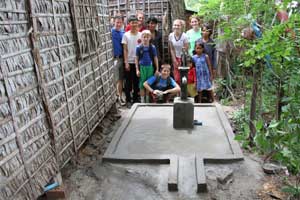
Filled with sorrow for the girl' s heartrending story and a desire for justice, the family was moved to consider how they might further enrich these children' s lives. The school had recently commenced a new project to expand the facilities but was restricted to complete the work within a certain time period, even though the necessary funds were not available. Stan and Lezlie consulted their family for how they would like to help, and they unanimously agreed they would love to contribute to the funding of the school' s new building.

well-family-and-chanda-and-usMotivating the family' s decision to help the children was the relentless reminder of the differences between their own lifestyle and that of the Cambodians. As Claudia describes, "We saw the difference " I have two computers, a cell phone, an air mattress, an iPhone, an iPad " and, these kids, all they have a long bench of wood for a bed with a picnic covering, two shelves in a room, and some books. Fifteen kids slept in a room just the size of my room."
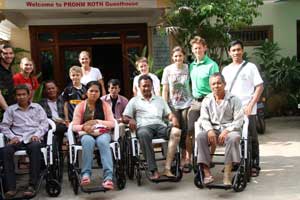
Both Claudia and her 17-year-old sister, Maggie, recognize that because of their age, their 10- and 13-year-old brothers, Caiden and Liam, may not have fully grasped the impact of poverty on the Cambodian people. But everyone agrees that having young volunteers on the trip made the experience all the richer. As the same age as most of the students, Caiden and Liam were able to relate with them in a special way, offering a unique connection. Liam explains his perspective on the experience: "It was really hard to understand how the Cambodians lived compared to how I live. The biggest difference was the way they acted " everyone was so happy and nice, as happy as the richest people over here. It was really different from what I was used to and eye opening to how privileged I am."

Walking away from the trip, the children of the family all realized that there is something rich and fulfilling in the lives of the Cambodians that the American culture may not have tapped into yet. Reflecting on this mystery, Claudia profoundly noted "I think they are so happy because they don' t have to worry about the social media and the money and the business and famous people and the media. It makes life so much more simple and so much more meaningful than getting a like on a Facebook picture." Even more notably, Maggie and Claudia were both impacted by the appreciation for education they saw from the Cambodian children. The girls were inspired that rather than complaining or begrudgingly go to school, as their peers often do, the kids were eager to learn and excited to soak up all the knowledge they could.

wheelchair-recipients-group-shotIn addition to funding the school project, the family' s help with FOCO in Cambodia has not halted since their return. Unable to shake the now-familiar realities of young children who live off a dollar a day and possess only one outfit to wear for the week, the four children have been inspired to continue their support of the students at FOCO. As Maggie recaps, "The work the school does is of such a benefit to the lives of these children and their communities, and the teachers and staff are really fun and caring people. I am so happy and grateful that I was able to be involved in this school, and I hope to continue to help even while in Dallas." And help she has, as she is currently in the planning stages of launching a literacy and pen pal project to connect peers at her school with students at FOCO.

Assuredly, any parent would be proud to hear their child respond to a volunteer experience with the openness, positivity, and initiative that this family' s children have demonstrated. But the development of characteristics like cultural awareness and generosity can only be attributed to the children' s first-hand observation of authentic parents who demonstrate compassion for humankind and a desire to contribute to other cultures. It is thanks to commendable parents such as these that global citizens rise up and take action to change the world.


Self

Volunteer trips that actually help

peru-volunteer-vacationsGreat CNN.com story from 2010 on volunteer vacations and finding the one that fits right and provides the greatest benefits to the destination community:

The idea of volunteering away from home seems like a win-win to many travelers: a way to experience and help another community at the same time. But without a solid, well-designed program and reasonable expectations, volunteer travel can do more harm than good.

Showing up in parts unknown, hoping to make a big difference in a small amount of time, is likely to leave travelers and hosts disappointed.

“You’re not going to change the world in a week or two. You’re not going to eradicate poverty in a village. You’re not going to teach a kid how to read,” said Doug Cutchins, a former Peace Corps volunteer and co-author of “Volunteer Vacations: Short-term Adventures That Will Benefit You and Others."

The key to having a positive impact in a short amount of time is realizing that your efforts are part of a process, Cutchins said. Results are subtle and come about slowly through a long line of volunteers.

“Development is a tricky process, and as Americans we are very, very product-oriented,” he said.

He’s concerned with what he calls “development by monument,” where volunteers want a completed building or another physical representation of their volunteer efforts to answer the inevitable “what did you accomplish?” question from friends and family at home.

“That’s one of the first questions you’re going to get asked, and it’s hard sometimes for people to say, ‘well, I was kind of part of a process, and we engaged in cultural exchange.’ But that’s really the very best way to do it,” Cutchins said.

Daniela Papi agrees. She is one of the founders of PEPY, a non-governmental organization dedicated to educational development in rural Cambodia. PEPY Tours hosts learning trips that help fund the group’s projects.

The organization has gone from referring to those trips as “voluntourism” to calling them “edu-tourism” or “educational adventures."

“The number one thing that’s going to happen is that you are going to have a new perspective on your country, on your life, on your choices and how they affect the world, on what it means to live in whatever country that is,” Papi said.

The 10 days or so spent traveling and learning would ideally inform participants’ choices and outlook at home, where they will have the largest impact, Papi said.

Finding volunteer trips that actually help – CNN.com http://www.cnn.com/2010/TRAVEL/05/31/voluntourism.tips/index.html 1 of 3 5/7/2013 1:47 PM Teaching English and construction projects are the most common types of voluntourism projects Papi sees in her region. Travelers involved in a construction voluntourism project should ask the operator and organizations involved about the plans for the structure when the volunteers go home, she cautions. Who is going to take care of it, who will work in it, how will they be trained, and who will fund the training? A poorly constructed school without trained teachers isn’t likely to have the benefits volunteers envision. And in the case of teaching English, who will teach the children when there are no volunteers, and what effect does a revolving-door model of teaching have on kids? Successful projects start with the needs of the community, voluntourism organizers say.

“We don’t go in and say, ‘this is what your problem is, and this is how we’re going to fix it,’ ” said Catherine McMillan, a spokeswoman for Globe Aware, a nonprofit that develops short-term volunteer programs.

Members of the community should be involved in identifying and addressing areas where partner organizations can help.

The organization you’re working with should have a strong and ongoing relationship with the community, local non-governmental organizations and project leaders on the ground.

“It’s a complicated kind of tourism, because you don’t want to send folks and do something and then not have, not measure the consequences of that action in the long term,” said Erica Harms, director of the Tourism Sustainability Council, an initiative involving the United Nations and travel partners.

Travelers should ask about the program’s history and its involvement with NGOs or other organizations. Find out where the funding is coming from and where it is being allocated. Ask about how the project is supported over time and how the community was involved in its development, Harms said.

And keep in mind that organizing volunteers to help support these efforts is not free. There are costs associated with housing and feeding volunteers, with transporting them locally, with training them and establishing a system of working that allows visitors to contribute for a short period.

Most of Globe Aware’s programs require a contribution fee of approximately $1,200 per week, which does not include airfare. PEPY Tours cost $500 to $700 a week, plus a fundraising or donation minimum of $500 for individuals.

PEPY Tours participants are giving back mostly through their financial support — which is what will keep the education projects running, Papi said. But visitors can see where their money is going and may have an opportunity to get physically involved.

Cutchins says reputable organizations will be up-front about costs, what is included and where your money will be spent.

Globe Aware’s McMillan recommends looking up nonprofits on Guidestar.org, which compiles tax forms from nonprofits, to see how operators are spending. It’s also a good idea to contact past volunteers or people who are familiar with the organization’s work on site.

Travelers should be realistic about what would make for a positive experience and select opportunities that fit their skills and interests.

“I think there are very few people who would make really bad volunteers. … It’s really about matching the Finding volunteer trips that actually help the right person with the right opportunity,” Cutchins said.

Archives